Good news and bad news to report regarding my pair of angelfish lovers.
First, the bad news: it appears that none of the angelfish babies that hatched this past week have survived in the community tank. There are a number of hiding places, however, so the possibility does exist that I will find a few who have remained well-hidden from me as well as predators.
The good news: once a pair of angels successfully lays eggs and sees them hatch, they are hooked. About every two weeks that they are without babies to care for, they will lay more eggs. This could go on for months -or even years- at a time.
So today I discovered that they had laid more eggs on the same intake.
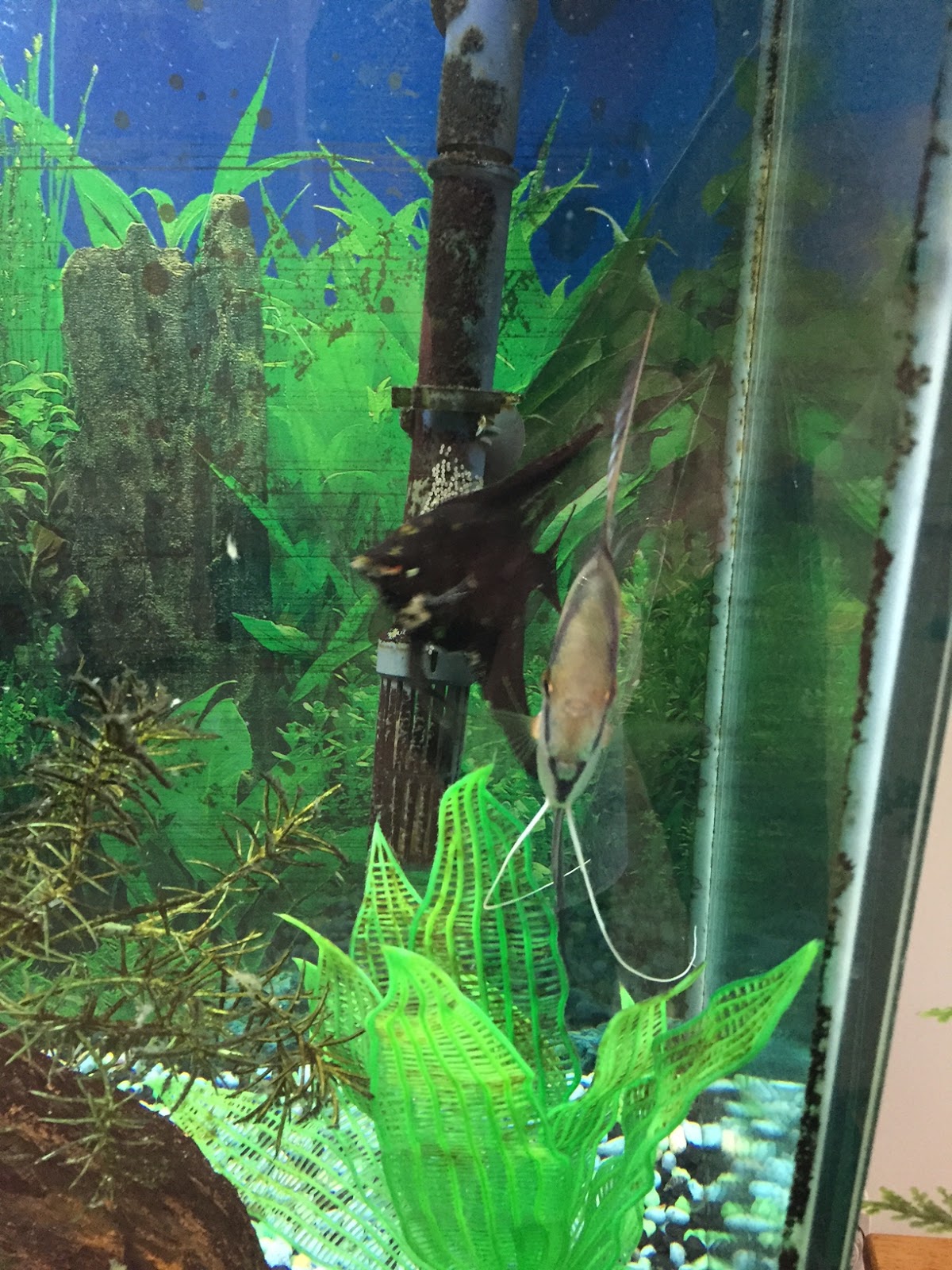
I had a dilemma.
If I allowed them to repeat the process of laying eggs in the community tank, I ran the risk that none of the babies would ever survive. Once they became free swimmers, it was just too much of a challenge to keep corydoras, plecos and tetras at bay.
I realized that because I'd removed the other angelfish to a separate community tank when John and Christy McFish decided to have a family, there were no predators in that tank that would bother my neon tetras, which had been housed in a separate, smaller tank. (Grown angelfish will eat neons.)
That is, there would be no predators if John and Christy McFish weren't there.
So today I moved all of the neon tetras, corydoras and two small plecos from their smaller tank (20 gallons) to the larger community tank (70 gallons) where they joined larger tetras and more corydoras. (I love corydoras; they seem like busy little Merry Maids.)
And I moved John and Christy McFish to the smaller tank, which is now officially the Honeymoon Suite.
The eggs on the intake were left behind, so they will be food for the fish that remained in the tank. However, once John and Christy realize they are all by themselves without any predators to harm their babies in the Honeymoon Suite, they'll lay eggs again. And this time, the babies have a much better chance of survival.
Stay tuned, and I'll post updates when they begin working on a family again!
p.m.terrell is the award-winning author of more than 20 books, including the Black Swamp Mysteries Series, which features CIA operatives who use an angelfish breeding facility as a front to cover their covert activities. Read Vicki's Key for details on raising angelfish from a breeder's perspective! And visit www.pmterrell.com for more infomation on all p.m.terrell's books!
Visit p.m.terrell's YouTube channel for videos on Angelfish Keeping and Breeding: https://www.youtube.com/user/terrellpm
Showing posts with label breeding fish. Show all posts
Monday, July 18, 2016
Thursday, February 5, 2015
Getting Acclimated
The new Stevie Fishnick is getting acclimated to her new surroundings. She spent just one hour in the bag getting adjusted to the temperature, and then I released her into the tank with Lindsay. I am hoping they will breed, which might take several weeks as they become accustomed to one another.
Soon after the video below was taken, Lindsay pecked a bit at Stevie so I placed a divider between them. The divider allows them to see one another but not to invade each other's space. I will try removing the divider after a few days to see if he accepts her.
Tuesday, February 3, 2015
Lindsay Gets a Mate
I haven't written much about Lindsay Buckingfish lately. His mate, Stevie Fishnick, died a few weeks ago. I tried moving Lindsay back into the community tank where he first lived but the male angelfish were extremely territorial and I was concerned for Lindsay's safety.
So Lindsay has been in the breeding tank all by his lonesome.
Last week, I learned from my friendly neighborhood pet shop, Carroll's Pets, that they had received a nice, large shipment of angelfish. The co-owner, Shelli, and I spent some time selecting what we think is a female.
We looked for:
(1) A head that slopes, versus one that rises sharply. Male angelfish get a bump on the top of their heads as they age; females do not.
(2) An angelfish remaining toward the back of the tank. Males tend to be more assertive and come to the front while females are content in the background.
(3) An angelfish that is not assertive when feeding. Females tend to allow the males to assertively rush to the top to eat.
(4) An angelfish without the barbs in the ventrals. Males have a barb that becomes more pronounced as they age; females do not.
The only surefire way to identify a female is when they mate, so we won't know for certain that I have a female for Lindsay until that time.
Here is Stevie Fishnick in the bag as it gets acclimated to the temperature. She is a red-eyed spangle. Lindsay's prior mates were both platinum angels, which looked identical to the new one except for the red eyes.
So Lindsay has been in the breeding tank all by his lonesome.
Last week, I learned from my friendly neighborhood pet shop, Carroll's Pets, that they had received a nice, large shipment of angelfish. The co-owner, Shelli, and I spent some time selecting what we think is a female.
We looked for:
(1) A head that slopes, versus one that rises sharply. Male angelfish get a bump on the top of their heads as they age; females do not.
(2) An angelfish remaining toward the back of the tank. Males tend to be more assertive and come to the front while females are content in the background.
(3) An angelfish that is not assertive when feeding. Females tend to allow the males to assertively rush to the top to eat.
(4) An angelfish without the barbs in the ventrals. Males have a barb that becomes more pronounced as they age; females do not.
The only surefire way to identify a female is when they mate, so we won't know for certain that I have a female for Lindsay until that time.
Here is Stevie Fishnick in the bag as it gets acclimated to the temperature. She is a red-eyed spangle. Lindsay's prior mates were both platinum angels, which looked identical to the new one except for the red eyes.
Tuesday, September 30, 2014
Redecorating a Community Tank
I liked the castles in Lindsay's and Stevie's Honeymoon Suite so much that I bought one for one of my community tanks.
Above, you can see two rare blue angels, a platinum marble angel named Emmie Lou who is the daughter of Lindsay and Stevie, and a blue marble angelfish. Emmie Lou (at the far left) is the only female. This tank is 55 gallons, and also contains corydoras and tetras.
Below is a video of their new digs:
Above, you can see two rare blue angels, a platinum marble angel named Emmie Lou who is the daughter of Lindsay and Stevie, and a blue marble angelfish. Emmie Lou (at the far left) is the only female. This tank is 55 gallons, and also contains corydoras and tetras.
Below is a video of their new digs:
Tuesday, September 23, 2014
Angels in the Community Tank
I have two community tanks with four angelfish in each one.
In this one, I have three males and one female. Normally, it's best to have things the other way around, as males can become quite territorial. This tank, however, is 70 gallons so there are places each male can go where they can not be seen by the others.
The oldest in this tank is John McFish. He is a silver angel around four years old. His mate, Christy McFish, was a smoky leopard who passed away some time ago.
The two koi angelfish are from the same brood. However, although one is male and one is female, they have never been interested in one another romantically - which might be a good thing, since they are brother and sister.
The female koi is interested in the blue marble angel, which is about the same age - around two years old. He is the alpha male in the tank, which might be why she is so interested in him. It is important for the male to be able to protect the eggs and fry from predators.
All of the angelfish get along just fine with the other fish in their tank.
In this one, I have three males and one female. Normally, it's best to have things the other way around, as males can become quite territorial. This tank, however, is 70 gallons so there are places each male can go where they can not be seen by the others.
The oldest in this tank is John McFish. He is a silver angel around four years old. His mate, Christy McFish, was a smoky leopard who passed away some time ago.
The two koi angelfish are from the same brood. However, although one is male and one is female, they have never been interested in one another romantically - which might be a good thing, since they are brother and sister.
The female koi is interested in the blue marble angel, which is about the same age - around two years old. He is the alpha male in the tank, which might be why she is so interested in him. It is important for the male to be able to protect the eggs and fry from predators.
All of the angelfish get along just fine with the other fish in their tank.
Tuesday, September 16, 2014
Update on the Honeymoon Suite
Lindsay Buckingfish and Stevie Fishnick seem to be enjoying the new decor in their honeymoon suite.
I have noticed them side by side staring at parts of the tank - the castles, the plant leaves, and even the glass. This is common when they are considering laying eggs. I would love to know how they communicate; I can imagine them asking each other if they think the conditions are right in that particular spot for the eggs to flourish.
Here is Lindsay; he is about ten inches tall and about two years old now. He's fathered several hundred eggs!
I have noticed them side by side staring at parts of the tank - the castles, the plant leaves, and even the glass. This is common when they are considering laying eggs. I would love to know how they communicate; I can imagine them asking each other if they think the conditions are right in that particular spot for the eggs to flourish.
Here is Lindsay; he is about ten inches tall and about two years old now. He's fathered several hundred eggs!
This is a small tank; only 20 gallons. Though books recommend five gallons for each angelfish, I allow ten gallons for each one. Only Lindsay and Stevie live in this one, so there are no predators and their eggs and fry would be safe.
Tuesday, September 9, 2014
Redecorating the Honeymoon Suite
It's been quite some time since Lindsay and Stevie mated. I tried twice to return them to the community tank. Stevie was accepted instantly, as female angels are, but Lindsay was bullied and might have been pecked to death had I not intervened.
So I decided that even if they do not breed again, the two needed to remain in the Honeymoon Suite. I didn't want to have Lindsay there all by himself, so Stevie and Lindsay are together again and have all the privacy they need.
However, when they were breeding, it was important to keep the tank spartan. This helps me to clean the tank without disturbing the baby angelfish. Now that they're no longer breeding, I decided to redecorate.
I am writing two books that center around an Irish castle. The first of these two will be released in 2015, and the second either in 2015 or 2016. Irish castles tend not to have spirals on their towers, but I fell in love with these two castles. It has created a fairytale atmosphere for the two lovers. They seem to be enjoying their new surroundings.
So I decided that even if they do not breed again, the two needed to remain in the Honeymoon Suite. I didn't want to have Lindsay there all by himself, so Stevie and Lindsay are together again and have all the privacy they need.
However, when they were breeding, it was important to keep the tank spartan. This helps me to clean the tank without disturbing the baby angelfish. Now that they're no longer breeding, I decided to redecorate.
I am writing two books that center around an Irish castle. The first of these two will be released in 2015, and the second either in 2015 or 2016. Irish castles tend not to have spirals on their towers, but I fell in love with these two castles. It has created a fairytale atmosphere for the two lovers. They seem to be enjoying their new surroundings.
Friday, September 5, 2014
Cuddle Time
My two Jack Russells, Eddie (with the blue collar) and Lucy (with the pink collar).
Notice there's no room for me?
Wednesday, August 27, 2014
The Lovers
Lindsay Buckingfish and Stevie Fishnick haven't bred in a long time. The last time they had babies, Lindsay got a sudden midnight snack obsession and thought his children were a sushi bar. Stevie was so angry that she bit him. I suspect that Stevie has decided never to lay eggs with him again.
So I decided to try and reintroduce them to the community tank. They both lived there until a couple of years ago, when they were mating so often that I needed to remove them to their own tank to protect the fry from predators.
Stevie was accepted immediately. Female angelfish are usually accepted without a problem, unless they go after a male who has already been claimed by another female.
Lindsay did not fare well at all. The other males had him cornered underneath a decoration and had I not been observing and ready to intercept, I think he would have been chewed pretty badly. Male angelfish are much more territorial and when a new male attempts to join the school, they can be vicious.
So rather than place Lindsay in a tank completely by himself, I moved both Stevie and Lindsay. Now I have plans to redecorate their tank. If they aren't going to lay more eggs, then I can add more decorations. However, I chose a castle with an eye toward the vertical lines, because angelfish lay their eggs on vertical surfaces. Who knows? The new digs might set them on a second honeymoon.
I'll post pictures of the new tank once all the new decorations are in!
So I decided to try and reintroduce them to the community tank. They both lived there until a couple of years ago, when they were mating so often that I needed to remove them to their own tank to protect the fry from predators.
Stevie was accepted immediately. Female angelfish are usually accepted without a problem, unless they go after a male who has already been claimed by another female.
Lindsay did not fare well at all. The other males had him cornered underneath a decoration and had I not been observing and ready to intercept, I think he would have been chewed pretty badly. Male angelfish are much more territorial and when a new male attempts to join the school, they can be vicious.
So rather than place Lindsay in a tank completely by himself, I moved both Stevie and Lindsay. Now I have plans to redecorate their tank. If they aren't going to lay more eggs, then I can add more decorations. However, I chose a castle with an eye toward the vertical lines, because angelfish lay their eggs on vertical surfaces. Who knows? The new digs might set them on a second honeymoon.
I'll post pictures of the new tank once all the new decorations are in!
Friday, June 27, 2014
Dramatic Pictures of Bettas
My two male bettas have been in top form lately. Their two-gallon round tanks sit side-by-side so they can see each other if they'd like to, but they also have plenty of private space.
Here is the double-fan-tail, a gorgeous pastel fish whose hues change from lavender to green depending on the lighting:
And here is the comb-tail betta, whose tail extends to look like a comb with the teeth set far apart. He is older than the pastel betta, so he is much larger. His colors are blue, green and red in deep, jewel tones:
Here is the double-fan-tail, a gorgeous pastel fish whose hues change from lavender to green depending on the lighting:
And here is the comb-tail betta, whose tail extends to look like a comb with the teeth set far apart. He is older than the pastel betta, so he is much larger. His colors are blue, green and red in deep, jewel tones:
The bubbles you see on the top of the water shows that each male is building a nest, hoping to attract a female. That means the water conditions are just right for them.
Tuesday, June 24, 2014
Lindsay Buckingfish and Stevie Fishnick
I haven't posted a lot lately about new baby angelfish because there hasn't been any in quite awhile. The couple I depend on most for laying eggs every few weeks has been on a hiatus for months. The last time they laid eggs, Lindsay thought the fry wasn't to his liking and decided to eat them. Or maybe they were too much to his liking. Stevie caught him in the act and tore into him. I removed them both to a separate tank and hand-raised their young on my own, eventually raising 17 to take to the local pet shop.
I don't know if Stevie was still angry with Lindsay and refused to have sex with him. Or maybe she was too traumatized by the sight of Her Babies' Daddy eating them. I tried changing their food to pure brine shrimp, specially designed for breeding. No luck.
This past weekend, I decided that it was too much work to clean so many tanks every week so I drained the infant tank. I moved Lindsay and Stevie to a community tank but that turned out to be short-lived. Stevie was accepted instantly, as most females are. Lindsay, however, was perceived as a threat by the other males and promptly driven into a corner. As I observed this, I realized Lindsay's eye had become injured so out he came and back to his original tank.
I added medicine to his tank that day and followed with Bionox the following day. Late yesterday, I moved Stevie, shown in this video below, back to the honeymoon suite. I decided since angelfish mate for life, they were better off together. Lindsay looked lonely in the tank by himself. And Stevie wouldn't leave the corner of the community tank, where she stared across the room at Lindsay.
This morning, Lindsay's eye is almost completely healed. I will continue with the medicine for a week, and then reassess his condition.
So the lovers are back together.
I don't know if Stevie was still angry with Lindsay and refused to have sex with him. Or maybe she was too traumatized by the sight of Her Babies' Daddy eating them. I tried changing their food to pure brine shrimp, specially designed for breeding. No luck.
This past weekend, I decided that it was too much work to clean so many tanks every week so I drained the infant tank. I moved Lindsay and Stevie to a community tank but that turned out to be short-lived. Stevie was accepted instantly, as most females are. Lindsay, however, was perceived as a threat by the other males and promptly driven into a corner. As I observed this, I realized Lindsay's eye had become injured so out he came and back to his original tank.
I added medicine to his tank that day and followed with Bionox the following day. Late yesterday, I moved Stevie, shown in this video below, back to the honeymoon suite. I decided since angelfish mate for life, they were better off together. Lindsay looked lonely in the tank by himself. And Stevie wouldn't leave the corner of the community tank, where she stared across the room at Lindsay.
This morning, Lindsay's eye is almost completely healed. I will continue with the medicine for a week, and then reassess his condition.
So the lovers are back together.
Tuesday, June 3, 2014
Mr. Blue Gets Two Female Friends
Last week I mentioned that my blue marble angelfish had lost his long-time mate. He was pretty blue, hanging out in a corner and staring at his own reflection in the glass.
So I moved Emmie Lou, the platinum marble angelfish who was born to Lindsay Buckingfish and Stevie Fishnick right here in my own home, into his tank. (Shown below)
Because one should never introduce just one angelfish to a different tank, I also moved Alfreda AKA Alfie, a koi angelfish.
If I introduce just one angelfish to a group of angels, the newcomer will often be the target of territorial issues and bullying. By introducing two at once, especially in a tank with only three others present, it changes the dynamics and there is less likelihood of bullying.
Both Emmie Lou and Alfie are females, which is also acceptable in a tank with three males. Had I introduced another male, I would have had definite problems.
So far, Emmie Lou and Alfie have taken up with Mr. Blue, which is exactly what I wanted to happen.
The largest angels in this tank are Walter and Jack, two huge (12 inch tall) blue angels. They are named for Grumpy Old Men Walter Matthau and Jack Lemmon, because they are always bickering. But they're brothers and I suspect if I moved one, they'd miss each other. Besides, nobody else wants to put up with them.
So I moved Emmie Lou, the platinum marble angelfish who was born to Lindsay Buckingfish and Stevie Fishnick right here in my own home, into his tank. (Shown below)
Because one should never introduce just one angelfish to a different tank, I also moved Alfreda AKA Alfie, a koi angelfish.
If I introduce just one angelfish to a group of angels, the newcomer will often be the target of territorial issues and bullying. By introducing two at once, especially in a tank with only three others present, it changes the dynamics and there is less likelihood of bullying.
Both Emmie Lou and Alfie are females, which is also acceptable in a tank with three males. Had I introduced another male, I would have had definite problems.
So far, Emmie Lou and Alfie have taken up with Mr. Blue, which is exactly what I wanted to happen.
The largest angels in this tank are Walter and Jack, two huge (12 inch tall) blue angels. They are named for Grumpy Old Men Walter Matthau and Jack Lemmon, because they are always bickering. But they're brothers and I suspect if I moved one, they'd miss each other. Besides, nobody else wants to put up with them.
Thursday, March 27, 2014
Vicki's Angelfish at 6 Weeks
Here's the last video I took of the latest batch of Vicki's Angelfish, named for a character in my Black Swamp Mysteries series.
They were 6 weeks old in this video. At 8-10 weeks, they are ready to go to the local pet shop. Shelli, one of the owners of Carroll's Pets in Lumberton, North Carolina, enjoys coming to my home and scooping out the angels herself. She gets to see the parents and the water conditions. She knows I clean all my tanks every weekend (one reason I am not checking emails over the weekend!) and I will not overcrowd my angels.
Overcrowding leads to angels that have squat bodies and short vertical fins. In severe overcrowding, their vertical fins can also be bent.
I tank-raise my angels, which allows me to monitor the water conditions. It also allows the fish to get accustomed to seeing humans and they come to equate humans with bearers of food.
In contrast, some large breeders have pond-raised angels. The water conditions are more natural, which can lead to big adjustments when the fish are sold to hobbyists intending to keep them in tanks. They are also frightened of humans, and spend more time hiding behind plants or turning their backs on anyone approaching the tank - they think if they can't see you, you can no longer see them.
If you buy a pond-raised angelfish, it really is imperative that you add amazon extract or blackwater extract to the tank. Without it, they often suffer vitamin deficiencies and shortened lives. They can get accustomed to humans but it's important not to frighten them and to approach the tank slowly until they get used to you. They always do better when placed with other angelfish who are already accustomed to humans; they learn faster that we will not harm them.
They were 6 weeks old in this video. At 8-10 weeks, they are ready to go to the local pet shop. Shelli, one of the owners of Carroll's Pets in Lumberton, North Carolina, enjoys coming to my home and scooping out the angels herself. She gets to see the parents and the water conditions. She knows I clean all my tanks every weekend (one reason I am not checking emails over the weekend!) and I will not overcrowd my angels.
Overcrowding leads to angels that have squat bodies and short vertical fins. In severe overcrowding, their vertical fins can also be bent.
I tank-raise my angels, which allows me to monitor the water conditions. It also allows the fish to get accustomed to seeing humans and they come to equate humans with bearers of food.
In contrast, some large breeders have pond-raised angels. The water conditions are more natural, which can lead to big adjustments when the fish are sold to hobbyists intending to keep them in tanks. They are also frightened of humans, and spend more time hiding behind plants or turning their backs on anyone approaching the tank - they think if they can't see you, you can no longer see them.
If you buy a pond-raised angelfish, it really is imperative that you add amazon extract or blackwater extract to the tank. Without it, they often suffer vitamin deficiencies and shortened lives. They can get accustomed to humans but it's important not to frighten them and to approach the tank slowly until they get used to you. They always do better when placed with other angelfish who are already accustomed to humans; they learn faster that we will not harm them.
Monday, March 24, 2014
Vicki's Angelfish at 5-6 Weeks
Here's a video of the latest batch of angelfish when they were between five and six weeks old. Some breeders will sell them when they are this size - their bodies are smaller than a quarter. In my opinion, they are too small to sell when they are this young, and they haven't had a chance to become strong and more robust.
I keep the angelfish until they are between 8 and 10 weeks old. By that time, their fins are tall and carried erect; they are stronger and more resistant to moving to new water and new tanks; and they've had a chance to get to know humans as beings who bring them food. :)
This batch of angels is from Lindsay Buckingfish, a 10-inch-tall black marble and his petite lover Stevie Fishnick, an 8-inch platinum. The result is 7 black marble angels and 10 white marble.
Friday, February 28, 2014
Playing in the Snow
Seems like we've gone from winter to spring and back to winter!
Here is a video of the dogs, Eddie (a Jack Russell), Lucy (a Jack Russell/ hound mix) and Simone (a collie) playing in the snow from a couple of weeks ago. All the snow is melted and now the storm is just a memory.
Thursday, February 27, 2014
Feeding Baby Angelfish
When angelfish first begin to swim, it's time to start feeding!
The first food I feed my angels are live brine shrimp and First Bites. Live brine shrimp will cause the fish to grow very quickly and become more robust. It's very easy to hatch brine shrimp; one of the easiest methods is with a brine shrimp hatchery. But you can purchase the eggs at any pet shop and by adding aquarium salt to the water and shrimp eggs, you can grow them in almost anything, from old milk jugs to glass jars.
First Bites is an alternative if you don't want to grow brine shrimp yourself. This is prepared especially for newly hatched fish, so it is miniscule. When a tiny spoonful is put into the water (I use an 1/8 of a teaspoon) it floats through the water like live "bait". Angelfish are born with the instinct to go after this tiny food in the water, as well as any algae forming on plant leaves or glass.
Now that the angelfish are four weeks old, I have switched to dried brine shrimp instead of live. By crumbling it into the water, it's larger than freshly hatched shrimp and a bit more filling.
Within the next couple of weeks, I will be adding dried fish flakes to their feeding. By the time the angelfish are between eight and ten weeks old, they will have been weaned completely off the brine shrimp and First Bites and will be eating a diet consisting solely of dried fish flakes. This allows them to settle in much more easily with a community tank.
The first food I feed my angels are live brine shrimp and First Bites. Live brine shrimp will cause the fish to grow very quickly and become more robust. It's very easy to hatch brine shrimp; one of the easiest methods is with a brine shrimp hatchery. But you can purchase the eggs at any pet shop and by adding aquarium salt to the water and shrimp eggs, you can grow them in almost anything, from old milk jugs to glass jars.
First Bites is an alternative if you don't want to grow brine shrimp yourself. This is prepared especially for newly hatched fish, so it is miniscule. When a tiny spoonful is put into the water (I use an 1/8 of a teaspoon) it floats through the water like live "bait". Angelfish are born with the instinct to go after this tiny food in the water, as well as any algae forming on plant leaves or glass.
Now that the angelfish are four weeks old, I have switched to dried brine shrimp instead of live. By crumbling it into the water, it's larger than freshly hatched shrimp and a bit more filling.
Within the next couple of weeks, I will be adding dried fish flakes to their feeding. By the time the angelfish are between eight and ten weeks old, they will have been weaned completely off the brine shrimp and First Bites and will be eating a diet consisting solely of dried fish flakes. This allows them to settle in much more easily with a community tank.
Tuesday, February 25, 2014
Angelfish Babies Learning Their World
I'm really happy to report that the angelfish babies are continuing to thrive. Just a week or two ago, they remained near the gravel, as close to the bottom of the tank as they could get. They traveled in a school and whenever I came near the tank, they moved to the far back.
As they've grown, however, and especially once I removed the plants they were hiding behind, they have become more confident with their surroundings. They've begun to swim from the bottom of the tank to the top. And they've fanned out, no longer feeling the need to remain in a school.
In the wild or in a community tank, plants or decorations with very small openings are necessary to keep the baby angelfish from being eaten by predators - even other (adult) angelfish. Remaining in a school can be necessary for survival as well.
But in an infant tank like I have set up, there are no predators. I don't even have corydoras or other bottom-feeding or algae-eating fish, because they can find newborn fry very tasty. So there are no predators and the angelfish are learning they are perfectly safe.
I've been asked about the sponge on the intake filter. I bought the sponge at my local pet shop and cut it so it slips onto the intake. This prevents very small and weak angelfish from being sucked into the filter. It also provides a place where brine shrimp can become lodged, which the babies will pick off without having to worry about getting sucked in. The water can still circulate through the filter, providing both filtering and water movement that is essential to keeping the water oxygenated.
As they've grown, however, and especially once I removed the plants they were hiding behind, they have become more confident with their surroundings. They've begun to swim from the bottom of the tank to the top. And they've fanned out, no longer feeling the need to remain in a school.
In the wild or in a community tank, plants or decorations with very small openings are necessary to keep the baby angelfish from being eaten by predators - even other (adult) angelfish. Remaining in a school can be necessary for survival as well.
But in an infant tank like I have set up, there are no predators. I don't even have corydoras or other bottom-feeding or algae-eating fish, because they can find newborn fry very tasty. So there are no predators and the angelfish are learning they are perfectly safe.
I've been asked about the sponge on the intake filter. I bought the sponge at my local pet shop and cut it so it slips onto the intake. This prevents very small and weak angelfish from being sucked into the filter. It also provides a place where brine shrimp can become lodged, which the babies will pick off without having to worry about getting sucked in. The water can still circulate through the filter, providing both filtering and water movement that is essential to keeping the water oxygenated.
Tuesday, February 18, 2014
Angelfish Begin to Form Their Shape
The angelfish are just over two weeks old, and they have begun to form their distinctive angelfish shape.
The more angels you have in one tank, the shorter and squatter they become. The more space each one has to grow, the more likely they are to have very tall fins.
It is difficult at this point to count the fry, but I believe there are close to three dozen in this 20-gallon tank, which should give them plenty of space to grow over the next few weeks. When they have reached a body size of a quarter, they will go to the local pet shop. Some breeders sell them when their bodies are the size of a dime. I believe this is entirely too small, as the water changes from the breeder to the pet shop and then to the buyer's tank often results in high fatalities.
I changed the water the day before this video was taken. Water can become very dirty with babies, because of the brine shrimp that is fed to them - it creates cloudier water than fish flakes, which they won't be able to eat for several more weeks. During the water change, I removed the plants. This confuses them for a day or two, but it makes it more likely for them to get used to me, so they won't hide from people in the pet shop - or in their new home. They'll come to associate people with food.
The more angels you have in one tank, the shorter and squatter they become. The more space each one has to grow, the more likely they are to have very tall fins.
It is difficult at this point to count the fry, but I believe there are close to three dozen in this 20-gallon tank, which should give them plenty of space to grow over the next few weeks. When they have reached a body size of a quarter, they will go to the local pet shop. Some breeders sell them when their bodies are the size of a dime. I believe this is entirely too small, as the water changes from the breeder to the pet shop and then to the buyer's tank often results in high fatalities.
I changed the water the day before this video was taken. Water can become very dirty with babies, because of the brine shrimp that is fed to them - it creates cloudier water than fish flakes, which they won't be able to eat for several more weeks. During the water change, I removed the plants. This confuses them for a day or two, but it makes it more likely for them to get used to me, so they won't hide from people in the pet shop - or in their new home. They'll come to associate people with food.
Friday, February 14, 2014
Loving the Snow
My collie, Simone, is loving the snow. This week, a more severe storm moved in (Pax) which brought a reported five inches of snow to Robeson County on Tuesday, and an estimated .75 inch of ice on Wednesday.
Though it shut down the town, Simone loved the cold so much that she spent part of her day sitting in the snow.
In case you're wondering if she was left out there for long, note the doggie door on the side of the house. :) The dogs have three doggie doors so they can come and go as much as they'd like. I have discovered, however, that they will run around and play in the snow for a few minutes, then come inside for Mommy to dry them off, they'll warm up, and a few minutes later, they're back outside in it!
Though it shut down the town, Simone loved the cold so much that she spent part of her day sitting in the snow.
In case you're wondering if she was left out there for long, note the doggie door on the side of the house. :) The dogs have three doggie doors so they can come and go as much as they'd like. I have discovered, however, that they will run around and play in the snow for a few minutes, then come inside for Mommy to dry them off, they'll warm up, and a few minutes later, they're back outside in it!
Wednesday, February 12, 2014
Babies Thriving
Since I moved the parents to a different tank, the babies have been exploring their tank more thoroughly. There are no predators so they are perfectly safe swimming about. There is no need for them to hide among the plants, as their parents were keeping them.
You can see the difference in size. The smallest are most likely female, and the largest are most likely the alpha males - the ones most likely to get to the food first, and who will be more assertive as they age. When looking for a pair, it's often best to select one of the largest (most likely, a male) with one of the smaller ones (most likely, a female). Getting two of the largest often means you've selected two males, which can result in territorial issues.
Subscribe to:
Posts (Atom)


